Researchers Discover New Clues About the Origins of the Universe
Scientists have uncovered new evidence that could help explain how the universe began and evolved in the moments following the Big Bang. Using advanced space telescopes and highly sensitive ground-based observatories, researchers are gaining deeper insight into the earliest phases of cosmic history.
The study focuses on faint signals and ancient radiation that date back nearly 13.8 billion years — close to the birth of the universe itself.
Tracing the Aftermath of the Big Bang
Shortly after the Big Bang, the universe was an extremely hot, dense environment filled with rapidly expanding energy and particles. As it cooled, matter began to form, eventually leading to the creation of stars, galaxies, and galaxy clusters.
One of the most important tools for studying this early period is the Cosmic Microwave Background (CMB) — faint radiation that still fills the universe today. By analyzing subtle fluctuations in this radiation, scientists can map the distribution of matter in the early universe.
The new findings provide refined measurements of these fluctuations, helping researchers better understand how small variations in density eventually formed the large-scale structures we see today.
The Role of Dark Matter and Dark Energy
The research also sheds light on the mysterious components that dominate the cosmos: dark matter and dark energy. Together, they make up about 95% of the universe, yet they remain largely invisible and poorly understood.
By studying early cosmic patterns, scientists can test theoretical models explaining how dark matter influenced galaxy formation and how dark energy drives the universe’s accelerating expansion.
Advanced Technology Driving Discovery
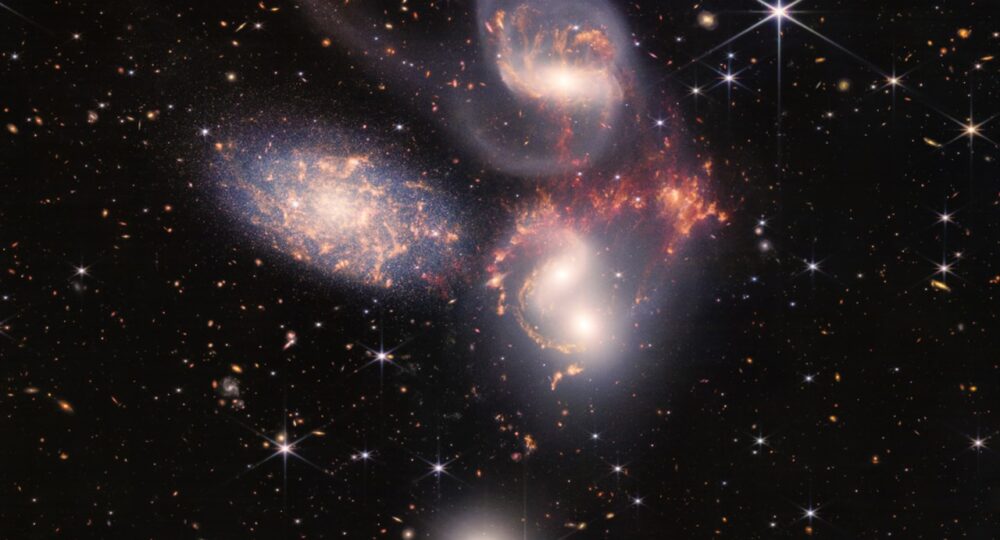
Recent observations from powerful instruments — including space-based observatories like the James Webb Space Telescope and detailed sky surveys conducted on Earth — have allowed astronomers to observe galaxies that formed just a few hundred million years after the Big Bang.
These observations challenge some previous assumptions about how quickly galaxies formed, suggesting the early universe may have evolved faster than scientists once believed.
A Step Closer to Understanding Everything
Understanding the origins of the universe remains one of humanity’s greatest scientific quests. Each new discovery brings researchers closer to answering fundamental questions:
-
What triggered the Big Bang?
-
How did matter first form?
-
Why does the universe have the structure we observe today?
While many mysteries remain, the latest findings represent a major step forward in cosmology. As next-generation telescopes and experiments come online in the coming years, scientists expect even more detailed insights into the earliest chapters of cosmic history.
The universe may be vast and ancient, but with every breakthrough, humanity is learning more about where it all began.