New Study Reveals How Supermassive Black Holes Grow So Rapidly
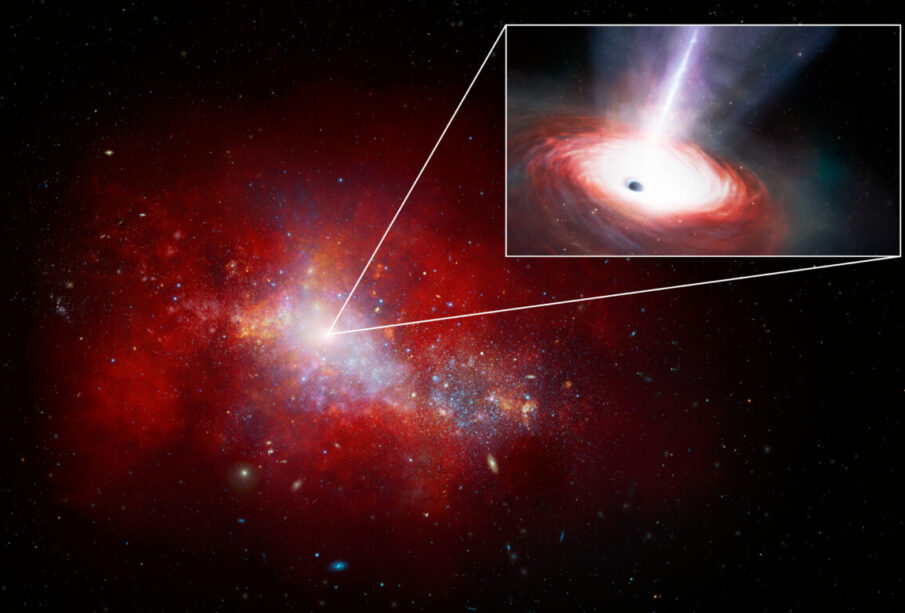
A groundbreaking new study is shedding light on one of astronomy’s greatest mysteries: how supermassive black holes grow so quickly in the early universe. These cosmic giants, found at the centers of most galaxies, including our Milky Way, can contain millions or even billions of times the mass of our Sun — but scientists have long struggled to explain how they reached such enormous sizes in a relatively short cosmic time.
The Mystery of Rapid Growth
Supermassive black holes are believed to grow by feeding on surrounding gas, dust, and even stars. As matter spirals inward, it forms a rapidly spinning accretion disk, heating up and emitting intense radiation before crossing the event horizon — the point of no return.
However, observations have revealed extremely massive black holes that already existed less than a billion years after the Big Bang. Under traditional growth models, there simply wouldn’t have been enough time for them to reach such massive sizes.
The new study suggests that these black holes may have experienced periods of “hyper-efficient” feeding, allowing them to grow at rates far beyond what was previously thought possible.
Super-Eddington Accretion
One of the key findings involves a process known as super-Eddington accretion. Normally, radiation pressure from infalling material pushes outward, limiting how fast a black hole can consume matter. But under certain extreme conditions, the inflow of gas can overwhelm this radiation pressure, allowing the black hole to feed at accelerated rates.
This rapid feeding phase could explain how supermassive black holes ballooned in size during the universe’s infancy.
Role of Galaxy Mergers
The study also highlights the importance of galaxy mergers. When galaxies collide, vast amounts of gas are funneled toward their central regions, providing a fresh supply of material for the black hole to consume. These violent cosmic interactions may trigger explosive growth spurts.
Observations from powerful telescopes such as the James Webb Space Telescope and the Atacama Large Millimeter/submillimeter Array (ALMA) have provided new data supporting these theories.
Understanding Cosmic Evolution
Supermassive black holes play a critical role in shaping galaxies. Their powerful jets and radiation can regulate star formation and influence the structure of their host galaxies. By understanding how these black holes grow, scientists gain deeper insight into how galaxies — including our own — evolved over billions of years.
The study marks an important step toward solving the puzzle of early black hole formation and opens new avenues for research into the origins of the universe’s most extreme objects.
As next-generation observatories come online, astronomers expect even more detailed observations that could further refine our understanding of these cosmic giants.