Scientists Discover Potentially Habitable Exoplanet Orbiting Nearby Star
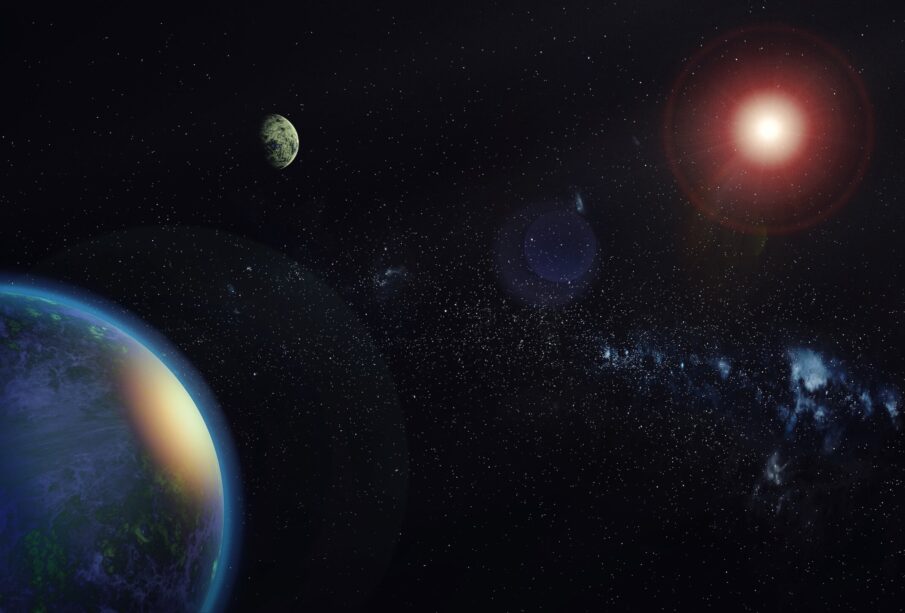
Astronomers have announced the discovery of a potentially habitable exoplanet orbiting a nearby star, raising exciting possibilities in the ongoing search for life beyond our solar system. The newly identified world lies within its star’s “habitable zone” — the region where conditions may allow liquid water to exist on a planet’s surface.
The discovery was made using advanced space- and ground-based telescopes that detect tiny dips in a star’s brightness when a planet passes in front of it, a method known as the transit technique. Follow-up observations helped scientists estimate the planet’s size, mass, and orbital characteristics.
A Promising New World
According to researchers, the exoplanet appears to be rocky and slightly larger than Earth — often classified as a “super-Earth.” Its host star is a relatively cool, red dwarf located only a few dozen light-years away, making it close in cosmic terms.
Because the planet orbits within the star’s habitable zone, temperatures may be suitable for liquid water — a key ingredient for life as we know it. However, scientists caution that being in the habitable zone does not automatically mean the planet is inhabited.
Studying the Planet’s Atmosphere
The next major step is analyzing the planet’s atmosphere. Using powerful instruments such as the James Webb Space Telescope, astronomers can study starlight passing through the planet’s atmosphere during transits. This helps identify gases like water vapor, carbon dioxide, methane, or even oxygen.
Detecting certain combinations of gases could hint at biological processes, although researchers emphasize that confirmation of life would require extraordinary evidence.
Why Nearby Exoplanets Matter
Finding potentially habitable planets around nearby stars is crucial for future research. Closer systems are easier to observe in detail and may one day become targets for next-generation space telescopes capable of directly imaging distant worlds.
Over the past decade, thousands of exoplanets have been discovered, but only a small fraction are considered potentially habitable. Each new discovery adds valuable data to our understanding of how common Earth-like planets might be in the galaxy.
A New Era in the Search for Life
This discovery highlights the rapid advancement of astronomical technology and the growing ability to identify worlds that could support life. Scientists believe that in the coming years, improved telescopes and observation methods will reveal even more promising candidates.
While the question of whether we are alone in the universe remains unanswered, discoveries like this bring humanity one step closer to finding out.