
James Webb Space Telescope Captures Stunning Image of Distant Galaxy Cluster
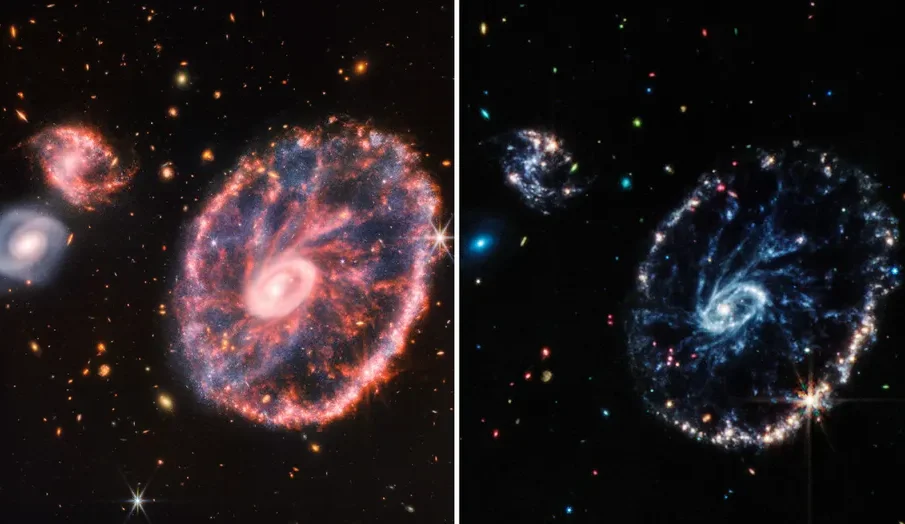
The James Webb Space Telescope (JWST) has once again amazed scientists and space enthusiasts by capturing a breathtaking new image of a distant galaxy cluster, offering one of the most detailed views of the early universe ever recorded.
The newly released image showcases thousands of galaxies packed into a single frame — some shining brightly in the foreground, while others appear faint and stretched due to a phenomenon known as gravitational lensing. This cosmic effect occurs when a massive galaxy cluster bends and magnifies the light from galaxies located far behind it, acting like a natural telescope in space.
A Window Into the Early Universe
Galaxy clusters are among the largest structures in the universe, containing hundreds or even thousands of galaxies bound together by gravity. By studying them, scientists can better understand how matter is distributed across the cosmos and how galaxies evolve over billions of years.
Webb’s powerful infrared instruments allow it to see farther back in time than any previous space telescope. Because light from distant galaxies takes billions of years to reach Earth, observing these objects is like looking into the past. Some of the galaxies visible in the image formed just a few hundred million years after the Big Bang.
Unprecedented Detail and Clarity
The image reveals intricate details, including:
-
Bright star-forming regions
-
Faint background galaxies never seen before
-
Distorted arcs of light caused by gravitational lensing
-
Extremely distant redshifted galaxies
Compared to earlier observations from the Hubble Space Telescope, Webb’s image provides sharper resolution and deeper infrared sensitivity, allowing astronomers to detect galaxies that were previously invisible.
Unlocking Cosmic Mysteries
Scientists are now analyzing the data to measure galaxy masses, star formation rates, and the distribution of dark matter within the cluster. Since dark matter cannot be seen directly, researchers use gravitational lensing patterns to map its presence.
The discovery not only deepens our understanding of galaxy formation but also helps refine models of how the universe evolved over time.
The Future of Webb Observations
Since its launch, the James Webb Space Telescope has revolutionized astronomy with groundbreaking images of nebulae, exoplanets, and distant galaxies. This latest galaxy cluster image further proves that Webb is entering a new golden age of space exploration.
As the telescope continues its mission, scientists expect even more extraordinary discoveries that could reshape our understanding of the cosmos.


